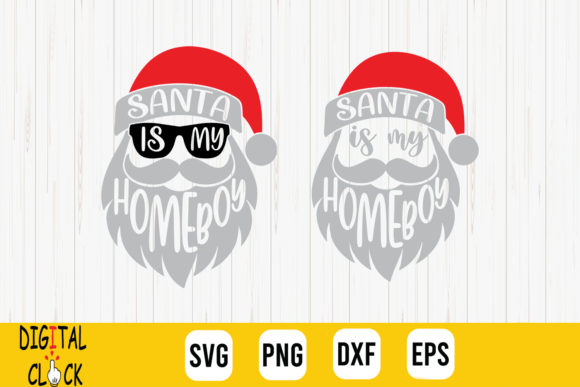
Santa is My Homeboy: A Designer’s Embroidery Review
As an embroidery designer who has spent years digitizing and testing thousands of files, I approach every new machine embroidery design with a mix of curiosity and skepticism. We have all seen the flood of holiday graphics that look fantastic on a screen but turn into a tangled mess of thread breaks and puckering on fabric. When I first pulled up Santa is My Homeboy Funny Santa Face, my immediate reaction was not just about the humor, but about the structural integrity of the artwork for real-world stitching.
This piece falls squarely into the category of T-Shirt Designs and digital Graphics, but its application extends far beyond simple printing. The phrase "Santa is My Homeboy" paired with a stylized Santa face creates a specific mood: irreverent, modern, and playful. It targets a demographic that wants holiday cheer without the traditional stiffness. For those of us running a craft business or working as an Etsy seller, understanding how this visual personality translates to thread is crucial before we commit to production.
First Impressions and Visual Personality
The layout of Santa is My Homeboy Funny Santa Face relies heavily on bold lines and clear shapes. In embroidery, clarity is king. Complex gradients and subtle shading often get lost in the translation from pixel to stitch. This design appears to favor high contrast, which is excellent for readability. The facial features of Santa are likely simplified, avoiding tiny, isolated stitches that can pull out during washing.
From a design perspective, the typography choice matters immensely. If the lettering is thick and blocky, it will hold up well under a fill stitch. If it is thin and script-like, it may require careful handling with a satin stitch or even a running stitch outline to prevent distortion. The "homeboy" aspect suggests a casual, streetwear-inspired aesthetic, which pairs naturally with heavier fabrics like cotton canvas or fleece rather than delicate silks.
Real-World Application: The Sweatshirt Test
To truly evaluate an embroidery file, I imagine it on a specific product. Let’s consider a custom sweatshirt embroidery project for a client who wants a unique holiday gift. A heather grey crewneck provides a neutral backdrop that allows the colors of the Santa face to pop.
In this scenario, the stitch density becomes a critical factor. A dense design on a soft, stretchy sweatshirt fabric can cause significant puckering if not stabilized correctly. I would recommend using a cut-away stabilizer to support the weight of the thread. The design’s placement on the left chest or as a larger back print would change how the viewer perceives the scale. On the chest, the details need to be minimal; on the back, you have more room for intricate thread colors and shading.
Another viable option is a tote bag design. Canvas bags are sturdy and handle high-density stitching beautifully. The humorous nature of Santa is My Homeboy Funny Santa Face makes it a perfect impulse buy for holiday shoppers looking for something different than the usual snowflakes and reindeer. It adds personality to a functional item, increasing the perceived value of the handmade product.
Navigating Fabric and Hoop Constraints
While this design is versatile, it is not without its challenges. Embroiderers must be cautious when applying it to certain materials. For instance, on a curved surface like a cap, the center of the design must align perfectly with the peak to avoid distortion. The facial features of Santa must remain symmetrical, which requires precise hooping.
Thin fabrics present another hurdle. If you attempt to stitch this on a lightweight t-shirt without proper backing, the fabric may tear or pucker around the edges of the letters. In such cases, using a no-show mesh stabilizer is essential. Additionally, dark fabrics require careful selection of thread colors. If the design includes white or light-colored elements for Santa’s beard or highlights, ensure your machine tension is calibrated to prevent the underlying fabric color from peeking through.
For those considering this for an embroidered patch, the design’s borders need to be clean. A merrowed edge or a satin stitch border can frame the graphic nicely, turning it into a standalone accessory that can be ironed or sewn onto jackets and bags later. This expands the utility of the digital embroidery file beyond direct-to-garment applications.
Commercial Viability and Brand Consistency
For small shop product lines, consistency is key. Santa is My Homeboy Funny Santa Face fits well within a brand that focuses on modern, quirky holiday decor. It appeals to younger demographics and those who appreciate irony. However, it may not suit a boutique specializing in traditional, heirloom-quality holiday embroidery.
When listing this as a custom apparel item or a personalized gift, transparency about the design’s limitations is important. Customers appreciate knowing that the item is handmade and may have slight variations. Using high-quality printable mockup images can help set expectations, showing how the design looks on different colored garments. This builds trust and reduces return rates.
Practical Notes for the Embroiderer
Before launching into a full production run, I always advise a few practical steps:
- Test on scrap fabric: Always stitch a sample on the same material you plan to use for the final product. Check for puckering, thread breaks, and color accuracy.
- Check stitch density: If the design feels too heavy, consider reducing the density in your editing software or adding more underlay stitches for stability.
- Verify licensing: Since the product description mentions SVG, PNG, EPS, and DXF files, clarify whether the license covers commercial use of finished physical items. Some digital sellers restrict the sale of mass-produced goods.
- Contrast check: View the design in black and white to ensure the shapes are distinct. If the details blur together, the design may need simplification for smaller hoop sizes.
- Wash test: After stitching, wash the sample item to see how the threads hold up. This ensures your finished product maintains its quality after customer use.
In conclusion, Santa is My Homeboy Funny Santa Face offers a fresh take on holiday design assets. It is not just a graphic; it is a statement piece that, when executed with proper technical skill, can elevate a simple garment into a memorable embroidery project. By respecting the constraints of the medium and understanding the audience, designers and makers can leverage this file to create successful, engaging products for the holiday season.